Idioms enriches language by adding color and nuance beyond literal meanings. If you're curious about what are some common idioms that pop up in daily conversations or media, they offer a window into cultural expressions and everyday wisdom. Let's dive into some phrases you’ll hear time and again—and learn how to use them naturally.
What Are Idioms That Describe Everyday Actions?

Idioms often capture routines or habits in vivid ways. For example, “hit the hay” means to go to bed, while “break the ice” refers to starting a conversation in social situations. These phrases stick because they’re relatable and concise. Think of “cold turkey” for quitting something abruptly or “bite the bullet” when facing a tough decision. They simplify complex ideas into memorable chunks.
Quick Examples to Try:
- “Call it a day” – to stop working or doing something for now.
- “Rule the roost” – to act like the boss in a group setting.
How Do Quantifiers Like “Some” Shape Idiom Meanings?

Quantifiers like “some” and “any” appear in idioms that hint at quantity or availability. For instance, “some” in “some people say…” introduces opinions, while “any” in “anybody can do it” emphasizes universality. These small words signal inclusivity or inclusivity in a way that’s deeply embedded in English culture. Phrases like “some things never change” or “you’re some character” show how “some” can imply admiration or observation.
Use in Practice:
- “Some enchanted evening…” – from a famous Italian movie, evoking nostalgia or longing.
- “There’sSomegood in everyone” – a reminder of hidden positivity in people.
Which Idioms Help Express Time and Change?
Time-sensitive idioms often hinge on expressions like “used to” or “be used to.” “Used to” describes past habits (e.g., “I used to play chess nightly”), while “be used to” explains adaptation (e.g., “She’s used to waking early”). Other time-based idioms include “when hell freezes over” (meaning never) or “in a jiffy” (very quickly). These phrases rely on shared cultural context to carry weight, making them worth mastering.
Examples for Your Vocabulary:
- “Time flies” – highlights how quickly moments pass.
- “Turn a blind eye” – to ignore something deliberately.
What Are Some Funny or Surprising Idioms?
Laughter often hides in unexpected places. Try “don’t count your chickens before they hatch” (don’t assume success early), or “spill the beans” (reveal a secret). Regional quirks like “raining cats and dogs” (heavy rain) or “barking up the wrong tree” (misunderstanding a problem) add flavor. These idioms stick because they’re visual and memorable—even when their origins are murky.
Try Inserting These:
- “It’s not rocket science” – to emphasize that something isn’t overly complex.
- “Piece of cake” – something very easy to accomplish.
Final Tips for Using Idioms Naturally
Start small: pick two or three idioms from lists like these and weave them into conversations. Notice how native speakers use them in context, then mimic the tone. Idioms thrive in casual settings, not formal lectures, so practice in low-pressure chats or writing exercises. Over time, they’ll slip into your vocabulary like second nature. Remember, the goal isn’t to memorize every idiom but to recognize and use the ones that fit your voice and audience.
Idioms enriches language by adding color and nuance beyond literal meanings. If you're curious about what are some common idioms that pop up in daily conversations or media, they offer a window into cultural expressions and everyday wisdom. Let's dive into some phrases you’ll hear time and again—and learn how to use them naturally.
What Are Idioms That Describe Everyday Actions?
Idioms often capture routines or habits in vivid ways. For example, “hit the hay” means to go to bed, while “break the ice” refers to starting a conversation in social situations. These phrases stick because they’re relatable and concise. Think of “cold turkey” for quitting something abruptly or “bite the bullet” when facing a tough decision. They simplify complex ideas into memorable chunks.
Quick Examples to Try:
- “Call it a day” – to stop working or doing something for now.
- “Rule the roost” – to act like the boss in a group setting.
How Do Quantifiers Like “Some” Shape Idiom Meanings?
Quantifiers like “some” and “any” appear in idioms that hint at quantity or availability. For instance, “some” in “some people say…” introduces opinions, while “any” in “anybody can do it” emphasizes universality. These small words signal inclusivity or inclusivity in a way that’s deeply embedded in English culture. Phrases like “some things never change” or “you’re some character” show how “some” can imply admiration or observation.
Use in Practice:
- “Some enchanted evening…” – from a famous Italian movie, evoking nostalgia or longing.
- “There’sSomegood in everyone” – a reminder of hidden positivity in people.
Which Idioms Help Express Time and Change?
Time-sensitive idioms often hinge on expressions like “used to” or “be used to.” “Used to” describes past habits (e.g., “I used to play chess nightly”), while “be used to” explains adaptation (e.g., “She’s used to waking early”). Other time-based idioms include “when hell freezes over” (meaning never) or “in a jiffy” (very quickly). These phrases rely on shared cultural context to carry weight, making them worth mastering.
Examples for Your Vocabulary:
- “Time flies” – highlights how quickly moments pass.
- “Turn a blind eye” – to ignore something deliberately.
What Are Some Funny or Surprising Idioms?
Laughter often hides in unexpected places. Try “don’t count your chickens before they hatch” (don’t assume success early), or “spill the beans” (reveal a secret). Regional quirks like “raining cats and dogs” (heavy rain) or “barking up the wrong tree” (misunderstanding a problem) add flavor. These idioms stick because they’re visual and memorable—even when their origins are murky.
Try Inserting These:
- “It’s not rocket science” – to emphasize that something isn’t overly complex.
- “Piece of cake” – something very easy to accomplish.
Final Tips for Using Idioms Naturally
Start small: pick two or three idioms from lists like these and weave them into conversations. Notice how native speakers use them in context, then mimic the tone. Idioms thrive in casual settings, not formal lectures, so practice in low-pressure chats or writing exercises. Over time, they’ll slip into your vocabulary like second nature. Remember, the goal isn’t to memorize every idiom but to recognize and use the ones that fit your voice and audience.
Some Vs Any | Meaning, Rules, Examples, Chart, And Exercises
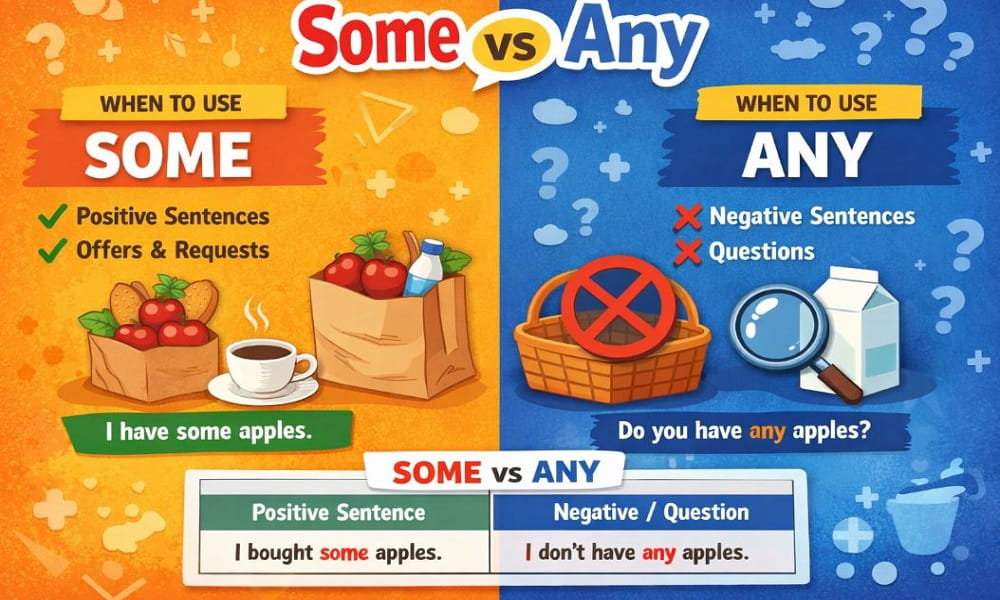
Some vs Any | Meaning, Rules, Examples, Chart, and Exercises
Using Some And Any In English – Artofit

Using some and any in english – Artofit
PPT - Understanding "Some" And "Any" In English Grammar PowerPoint

PPT - Understanding "Some" and "Any" in English Grammar PowerPoint ...